
A Cloud That Refused to Make Sense
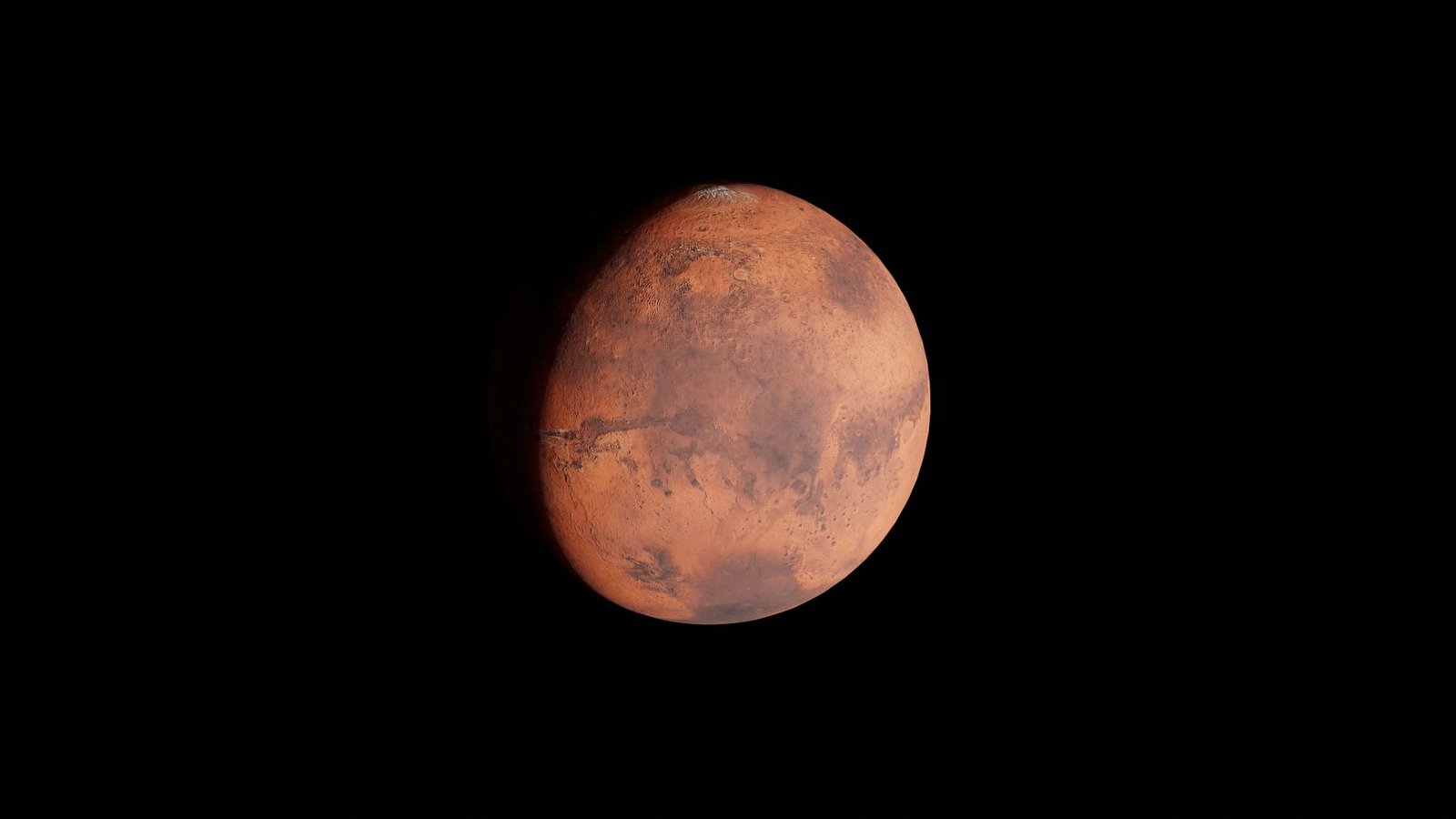
Every morning during the Martian spring and summer, a thin, ribbon-like cloud forms above the slopes of Arsia Mons, one of the giant volcanoes that dominate the planet’s Tharsis region. It stretches outward, growing steadily longer until it spans more than 1,000 miles, roughly the distance between New York and Kansas City if you could fly in a straight line. Then it fades away, only to return the next day and repeat the performance for months at a time.
A probe first recorded this phenomenon in 2018, and since then it has been known to researchers as the Arsia Mons Elongated Cloud, or AMEC. For years, nobody could explain it. Conventional models of Martian weather, which handle dust storms, carbon dioxide ice clouds, and water ice formations reasonably well, simply failed to reproduce anything resembling this long, persistent streak.
Why a Computer Model Changed the Conversation
That picture may finally be shifting. Researchers have now produced the first successful simulation of the cloud’s formation, and the results point toward an explanation few expected. To make the model match what satellites had observed, the team had to incorporate a set of physical processes that appear in textbooks but are generally treated as theoretical. In other words, the math worked only when the simulation allowed for behavior that scientists have never directly witnessed operating inside a planetary atmosphere.
Jorge Hernández-Bernal, a planetary scientist at Sorbonne Université and lead author of the study, described the moment plainly. Once the unusual physics was added, the cloud emerged in the simulation just as the team had hoped. That kind of outcome is exciting for researchers, because it suggests the gap in our understanding was not a fluke of observation but a real feature of how planetary air behaves under certain conditions. It also reminds us that Mars, a world we have studied for decades, can still surprise us.
What This Means Beyond the Red Planet
Discoveries like this matter well beyond the scientific community. Accurate atmospheric models underpin the navigation, landing, and climate planning for every mission we send to Mars, and they inform how we interpret data from Earth’s own atmosphere, where many of the same fluid dynamics principles apply. If an overlooked physical process can shape a cloud the size of a continent on another world, it raises fair questions about what else our models might be missing here at home.
For consumers, the story carries a quieter lesson about where technology is heading. The sensors, cameras, and simulation software that made this discovery possible are increasingly available in everyday devices, from weather-tracking gadgets to the powerful laptops and cloud services researchers use to run complex models. As interest in space science and home weather technology grows, shoppers are showing stronger intent to buy tools that bring this kind of precision into their own lives, and that demand is driving faster innovation across the hardware market.